


Tasting Barons de Rothschild Champagne
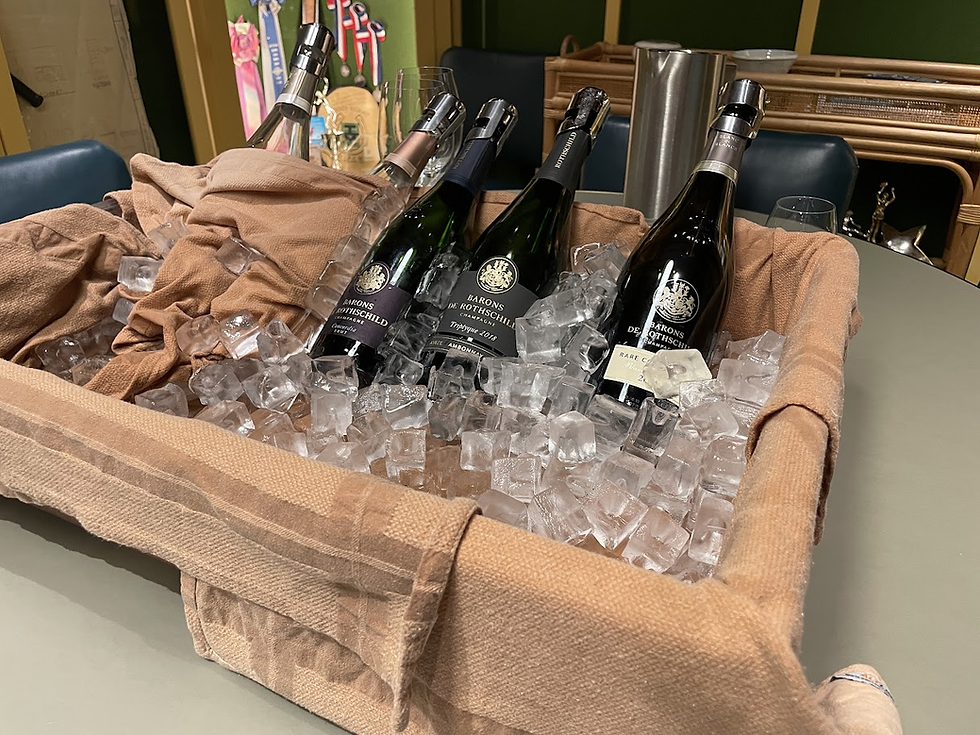
by Andrew Chalk
Rothschild -- in the wine world the name is synonymous with Bordeaux. Three parts of the family own the first growths Château Mouton Rothschild, Château Lafite Rothschild, and the jewel of the Listrac-Medoc appellation, Château Clarke. They combined in 2005 to create Champagne Barons de Rothschild with the vision of it being a Grand Vin de Champagne.
All the quality markers are in place:
A varietal commitment: In their case to Chardonnay which makes up no less that 50%-60% of the cépage of all their Champagnes.
Grand and Premier Cru grapes: The Champagne region classifies its villages by quality tiers. 90% of the House’s grapes come from Grand Cru and Premier Cru villages. The chosen area are the Côte des Blancs and the Montagne de Reims where the House works closely with growers of over 80 hectares (200 acres) of grapes on long-term multi-year contracts.
Reserve Wines: Over 40% of the blend of non-vintage wines (the most popular style in the marketplace) are composed of reserve wines (the wine stored from previous vintages, partially drawn down each year, and then supplemented by the most recent vintage). This percentage is unusually high. The effect I noticed in tasting was that the House’s nonvintage wines (see below) had acquired an aged quality that contributed an extra dimension to the tasting experience.
Purity of Dosage: The House’s term for low, zero to 6 grams per litre, of dosage (AKA sweetener). This made for a dry style and should be compared with the permitted level of up to 12 g/l for Brut wines. All of the House wines could in fact be sold as Extra Brut rather Brut if the House wished. Why take this measure? The House explains that they do this “allowing the origin of the wine and the typical character of the terroirs to show through unimpeded”.
Aging: A foundational technique in Bordeaux. The House says “Aged on fine lees for over 9 months to reveal the complexity of the plots and aged in bottles for 3.5 to 4 years for non-vintage cuvées, and up to over 10 years for vintage cuvées. This patience allows the cuvées to reveal their greatness and purity.”
In the sloth-like timescale of the wine world, a 2005 founding makes Champagne de Barons de Rothschild a veritable startup, and the winery, in Vertus, was completed only in 2025 (after renovating a premises acquired in 2013). There, they employ a plot-by-plot approach to winemaking using stainless steel, wooden, and concrete vats in the winemaking.
The aging and production phase (riddling, disgorging, labeling and packing) takes place in another facility, in Oger. It is semi-buried in chalk and 100% solar-powered.

While the wines have been in the US market for many years, 2026 was the first time that Guillaume Lété, chief winemaker at Champagne Barons de Rothschild had been to Dallas. Guillaume is currently 38 years old. He joined Champagne Barons de Rothschild in 2011, and has been chief winemaker since 2016. I recently had the pleasure to attend a tasting of some of the current non-vintage and vintage wines.

Blanc de Blancs
Champagne Barons de Rothschild currently produces a total of around 50,000 cases (a ‘large boutique’ level of output). The Blanc de Blancs might be described as their go-to-market wine against the other nationally-distributed Champagne houses. They use its 100% Chardonnay combined with a large percentage of reserve wine to offer a weightier, more aged wine that many will prefer over lighter, flowery wines in this category.
BLENDS & TERROIRS
‒ 100 % Chardonnay
‒ 100 % Grand and Premier Crus : mainly from Avize, Le Mesnil-sur-Oger and Oger
‒ 40 % of reserve wines, the majority of which are kept in perpetual reserve
PRODUCTION
‒ Exclusive use of the cuvée
‒ Alcoholic and malolactic fermentation mainly in stainless steel vats, 5% in barrels and concrete ovoid vats
‒ Extended ageing on fine lees for 9 months - Bottling in July
‒ Ageing on lees after bottling: 4 years minimum
‒ Dosage: Extra Brut, 5.5 g/L
FOOD PAIRING & SERVING
It is a perfect accompaniment to seafood or lobster with a dash of lemon or grilled sea bass with dill. These dishes will bring out the champagne’s saline and mineral character. For dessert, it will pair perfectly with a tangy lemon tart.
Recommended serving temperature: around 10°C

Rosé
It may be one of the most refined rosé wines you taste. The Pinot Noir here hints rather than shouts.
BLENDS & TERROIRS
‒ 94% Chardonnay - 6% Pinot Noir red wine
‒ 100% Grand and Premier Crus, mainly from Chouilly, Cramant, Avize, Oger, Le Mesnil-sur-Oger, and Vertus for the Chardonnay; Exclusively Ambonnay for the Pinot Noir
‒ 40% reserve wines, most of which are kept in perpetual reserve
PRODUCTION
‒ Exclusive use of the cuvée
‒ Alcoholic and malolactic fermentation mainly in stainless steel vats, 5% in barrels and concrete ovoid vats
‒ Red vinification of Pinot Noir, harvested at optimal maturity and sorted manually on a table, using an infusion approach
that promotes gentle and controlled extraction.
‒ Extended ageing on fine lees for 9 months - Bottling in July
‒ Ageing on lees after bottling: 3 years minimum
‒ Dosage: Extra Brut, 5.5 g/L
FOOD PAIRING & SERVING
This champagne will pair particularly well with Asian or Japanese cuisine full of umami flavours. Sushi, sashimi or tuna tartar, as well as truffled veal or pink lamb. It is also a perfect accompaniment to desserts that are not too sweet, such as red fruit soup.
Recommended serving temperature: between 8 and 10°C

Concordia Brut
The blend adds more Pinot Noir which contributes oomph. In the category of powerful Champagnes like Bollinger.
BLENDS & TERROIRS
‒ 60% Chardonnay - 40% Pinot Noir
‒ 40% reserve wines, most of which are kept in perpetual reserve
‒ Over 85% Grand and Premier Cru vineyards, mainly Chouilly, Cramant, Avize, Oger, Le Mesnil-sur-Oger, Vertus, Trépail and Villers-Marmery for the Chardonnay; Mailly, Verzenay, Ambonnay, Bouzy, Louvois, Mareuil-sur-Aÿ, Aÿ and Cumières for the Pinot Noir
PRODUCTION
‒ Exclusive use of the cuvée
‒ Alcoholic and malolactic fermentation mainly in stainless steel vats and 5% in barrels
‒ Extended ageing on fine lees for 9 months - Bottling in July
‒ Ageing on lees after bottling: 3.5 years minimum
‒ Dosage: Brut, 6 g/L
FOOD PAIRING & SERVING
Ideal as an aperitif or enjoyed throughout a meal with dishes such as gently fried sea scallops, shellfish or rockfish. You can also pair it with a risotto, fine white meat or a farmhouse Brie de Meaux cheese.
Recommended serving temperature: 8-10°C

Triptyque 2018
I love the rich autolyzed flavors of old vintage Champagne and this example has them.
BLENDS & TERROIRS
3 Grands crus only:
‒ 50 % Chardonnay from Avize
‒ 25 % Pinot Noir from Ambonnay – 25% Pinot Noir from Aÿ.
PRODUCTION
‒ Exclusive use of the cuvée
‒ Alcoholic and malolactic fermentation in temperature-controlled stainless steel vats
‒ Extended ageing on fine lees for 9 months in stainless steel vats – Bottled in July
‒ Ageing on the lees after bottling: 65 months
‒ Dosage: Extra Brut, 5 g/l
‒ Disgorgement date: June 2024
‒ Production : 6,515 bottles, 800 magnums
FOOD PAIRING & SERVING
This cuvée is the perfect aperitif. It also goes well with shellfish, such as raw langoustines or roast lobster, or poultry with a refined sauce, such as guinea fowl with morel mushrooms.
Best served between 10 and 12°C.
This wine has a very good cellar ageing potential.

Rare Collection 2014 Blanc de Blancs
Even more welcome to old Champagne lovers than the previous wine. I would sip this over a game of World Cup Soccer. Food would detract from the complex yeasty flavors.
BLENDS & TERROIRS
‒ 100% Chardonnay
‒ 4 Grands crus exclusively from the Côte des Blancs: Avize, Cramant, Oger, Le Mesnil-sur-Oger.
PRODUCTION
‒ Exclusive use of the cuvée
‒ Parcel vinification mainly in stainless steel vats and 15% in barrels.
‒ Extended ageing on fine lees for 9 months with regular bâtonnage (stirring of the lees)
‒ Ageing on lees after bottling: 8 years minimum
‒ Dosage: Extra Brut, 4 g/l
‒ 2014 vintage production: 13,000 bottles, 2000 magnums.
FOOD PAIRING & SERVING
This exceptional champagne offers endless possibilities for gastronomic pairings and is particularly well suited to more delicately flavoured dishes. It is the ideal match for squid in a lemon sauce served with fresh garden vegetables, a delicately spiced chicken supreme or a veal medallion with morel mushrooms.
Best served between 10 and 12°C.
This wine has very good cellar-ageing potential
The AI Take - What Plaud Recorded and Inferred
Here.


Comments